 21umas.edu.ye
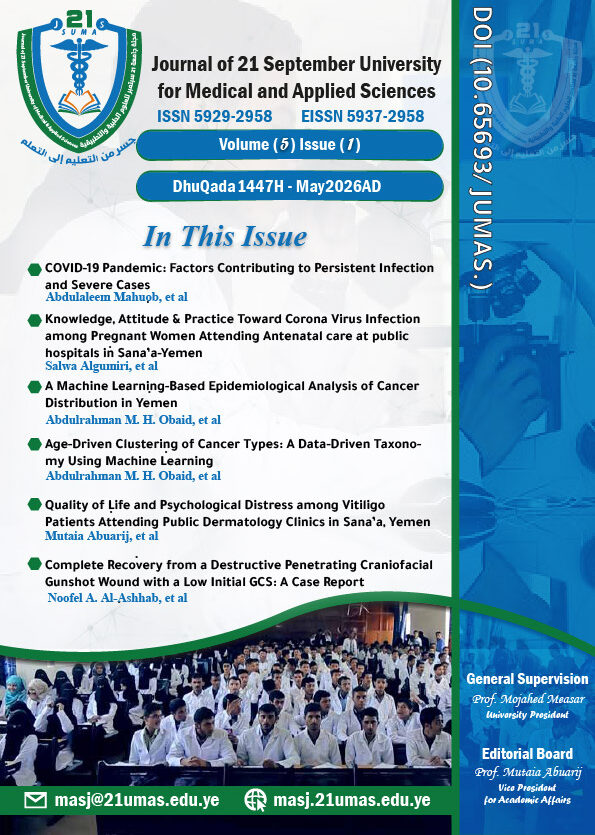
In This Issue
- COVID-19 Pandemic: Factors Contributing to Persistent Infection and Severe Cases Abdulaleem Mahuob, et al.
- Knowledge, Attitude & Practice Toward Corona Virus Infection among Pregnant Women Attending Antenatal care at public hospitals in Sana’a-Yemen Salwa Algumiri, et al.
- A Machine Learning-Based Epidemiological Analysis of Cancer Distribution in Yemen Abdulrahman M. H. Obaid, et al.
- Age-Driven Clustering of Cancer Types: A Data-Driven Taxonomy Using Machine Learning Abdulrahman M. H. Obaid, et al.
- Quality of Life and Psychological Distress among Vitiligo Patients Attending Public Dermatology Clinics in Sana’a, Yemen Mutaia Abuarij, et al.
- Complete Recovery from a Destructive Penetrating Craniofacial Gunshot Wound with a Low Initial GCS: A Case Report Noofel A. Al-Ashhab, et al.
# COVID-19 Pandemic: Factors Contributing to Persistent Infection and Severe Cases
Abdulaleem Mahuob, Khaled Alkhali, and Lyna Irawati
Abstract: Presently it is an era of viral foes against humanity. No one could expect the breakout of a new viral epidemic unless we make efforts to investigate new viruses in the wildlife and wet meats of exotic animals. Despite the prolonged duration of lockdown to control the transmission and the recovery of infected patients with SARS-CoV-2 virus, there are many new cases and deaths. Reviewing the literature provides the rationale behind daily reported new cases and deaths. Incomplete clearance of the virus new mutated genomic variants or a lack of immunisation against the virus could lead to re-infection or persistent infection. The severity of COVID-19 could be due to co-infection with other pathogens, chronic infections, nosocomial infections, highly virulent variants of the virus, or highly upregulated angiotensin-renin converting enzyme receptors II (ACE-II) in patients who have a history of hypertension, chronic chest infections or diabetes. Even after the lockdown is over, we should maintain good personal hygiene, physical distancing, wear face mask and gloves. Developing a safe and effective vaccine and antiviral agents could control the transmission and epidemic of SARS-CoV-2 virus.
Keywords: COVID-19, Pandemic, COVID-19, Infection, Severe cases
More details
# Knowledge, Attitude & Practice Toward Corona Virus Infection among Pregnant Women Attending Antenatal care at public hospitals in Sana’a-Yemen
Salwa Algumiri, Muneera Shaher, Fares Mahdi and Mohammed Aleriani
Background: The novel COVID-19 virus is a new respiratory infection that originated in Wuhan, China, and rapidly spread worldwide. The World Health Organization (WHO) has labeled it the “pandemic of the century.” While pregnant women do not appear to be at a higher risk of contracting SARS-CoV-2, the virus that causes COVID-19, studies indicate they have an increased risk of developing severe illness compared to non-pregnant women of similar age. Objective of the Study: This study aimed to assess the knowledge, attitudes, and practices (KAP) regarding COVID-19 among pregnant women attending antenatal care at public hospitals in Sana’a, Yemen. Methods: A KAP study was conducted from November 2022 to December 2022 to evaluate knowledge, attitudes, and practices about COVID-19. This study included a sample size of 205 pregnant women selected using a multistage random sampling method. Data were collected through a structured questionnaire covering demographic variables, knowledge, attitudes, and practices regarding COVID-19. Statistical analysis was conducted using SPSS version 26. Descriptive statistics (frequency and percentage) were used, and chi-square tests were applied to assess the relationship between independent and dependent variables. A two-tailed p-value <0.05 was considered statistically significant. Results: The study results showed that the majority of pregnant women (37.2%) were aged between 23 and 27 years. Most participants (80%) resided in urban areas, and 86.8% were housewives. In addition, 74.6% of pregnant women had received formal education. A majority (53.7%) believed that getting pregnant during the pandemic was unsafe. Most pregnant women (91.7%) reported changes in their diet and took additional nutritional supplements to boost their immunity against COVID-19. Anxiety regarding complications for both mother and baby was high (77.1%). Conclusions: The study found that a majority of pregnant women (53.7%) considered pregnancy during the pandemic unsafe. Additionally, 90.7% demonstrated a positive attitude towards preventive measures against COVID-19
Keywords: Knowledge, Attitude, Practice, Coronavirus Infection, Pregnant Women, Antenatal care
More details
# A Machine Learning-Based Epidemiological Analysis of Cancer Distribution in Yemen
Abdulrahman M. H. Obaid, Gameil S. H. Ali, Yousif A. Alhaj, Awadh Ali Abdo Mohammed
Background: Cancer represents a severe public health crisis in Yemen. Current literature lacks the regional granularity required for effective policy. To bridge this gap, the authors parsed 5,226 clinical records from the National Oncology Centre, mapping the spatial and demographic dispersion of the disease across all governorates. After scrubbing raw data for inconsistencies, the authors deployed Random Forest classification and hierarchical clustering to quantify patient demographics, temporal shifts, and regional incidence rates. Cases cluster heavily in specific regions. Ibb, Taiz, and Dhamar alone account for over one-third of the total national caseload. Breast cancer is the primary diagnosis. Most patients fall within the middle-adulthood cohort. Hierarchical clustering partitioned the governorates into subgroups with shared oncological profiles, providing a framework for localized intervention. The machine learning models yielded a Top-1 accuracy of 0.192 and a Top-3 accuracy of 0.596. These metrics reflect the high diagnostic heterogeneity and the asymmetric distribution of cases inherent to the Yemeni landscape. This work establishes an empirical baseline for national cancer planning. These results enable evidence-based resource management and prevention programs tailored to regional epidemiological realities.
Keywords: Cancer epidemiology; Yemen; Machine learning; Random Forest; Cancer prevalence; Geographical distribution.
More details
# Age-Driven Clustering of Cancer Types: A Data-Driven Taxonomy Using Machine Learning
Abdulrahman M. H. Obaid, Yousif A. Alhaj, Gameil S.H. Ali, Awadh Ali Abdo Mohammed
Background: Global mortality remains heavily driven by cancer, with patient age serving as a primary determinant of both incidence and pathological distribution. This study evaluates the predictive weight of age on cancer typology through an unsupervised machine learning lens, utilising a dataset of over 5,000 de-identified records from the National Oncology Centre in Yemen. The authors constructed a Python-based analytical framework to handle data preprocessing and imputation, subsequently comparing the efficacy of K-Means, Agglomerative Clustering, and Gaussian Mixture Modelling (GMM). GMM proved the most robust approach, yielding a Silhouette Score of 0.6135. Consequently, this model formed the basis for the final analysis. To ensure the clusters reflected genuine biological trends rather than stochastic noise, the authors validated the results using ANOVA and Chi-Squared tests. The analysis identified two distinct, age-stratified cohorts. The first, encompassing patients aged 2–40, showed a higher prevalence of bone marrow, lymphatic, thyroid, and breast malignancies. In contrast, the older cohort (ages 41–101) was characterised largely by breast and gastrointestinal cancers. These results establish age as a measurable, objective predictor of cancer distribution. Such findings suggest that clinical screening protocols and diagnostic priorities must be calibrated more closely to specific age demographics to enhance early detection efforts.
Keywords: Age determinant, cancer distribution, machine learning, clustering, Gaussian Mixture Model.
More details
# Quality of Life and Psychological Distress among Vitiligo Patients Attending Public Dermatology Clinics in Sana’a, Yemen
Mutaia Abuarij, Muneera Shaher, Ammar Awad
Introduction: Vitiligo is a chronic depigmenting disorder associated with a significant
psychosocial burden. Beyond cosmetic disfigurement, vitiligo may negatively influence
quality of life (QoL), treatment adherence, and psychological well-being, particularly in
low-resource settings such as Yemen.
Objectives: This study aimed to assess the quality of life and psychological distress among patients with vitiligo attending public dermatology clinics in Sana’a, Yemen.
Methods: A hospital-based cross-sectional study was conducted between November 2023 and May 2024 in three public hospitals in Sana’a. Patients with vitiligo aged 13-40 years were consecutively recruited. Data were collected using a structured questionnaire, the Arabic
version of the Dermatology Life Quality Index (DLQI), and the Depression, Anxiety, and Stress Scale (DASS-21). Statistical analysis was performed using SPSS version 26.
Results: A total of 118 patients participated. Quality of life impairment (DLQI ≥2) was
observed in 91.5% of patients, with a mean DLQI score of 8.35 ± 6.23. Depression, anxiety, and stress were reported in 33.1%, 33.9%, and 38.1% of patients, respectively. Marital status and education level were significantly associated with QoL impairment.
Conclusion: Vitiligo imposes a substantial psychosocial burden on Yemeni patients.
Integrating psychological assessment and support into dermatological care is essential to
improve patient outcomes.
Keywords: Vitiligo, Quality of Life, Psychological Distress, DLQI, Yemen.
More details
# Complete Recovery from a Destructive Penetrating Craniofacial Gunshot Wound with a Low Initial GCS: A Case Report
Noofel A. Al-Ashhab, Sakhr Alfaqih, Mohamed Shamsaldin
Background: Penetrating craniofacial gunshot wounds (GSWs) are among the most lethal forms of traumatic brain injury (TBI). Civilian survival rates are frequently below 15%, and mortality rates approach 80–98% in patients presenting with a Glasgow Coma Scale (GCS) score ≤5. Although admission GCS is the strongest predictor of outcome, limited cases of meaningful recovery suggest that prognosis should not rely on GCS alone.
Case Presentation: A 25-year-old man presented one hour after a self-inflicted point-blank craniofacial gunshot wound. On arrival, he was hypotensive (80/50 mmHg), hypoxic (SpO₂ ~60%), and comatose with GCS 5 (E1V1M3). Examination revealed a large destructive left craniofacial wound with exposed brain tissue, a ruptured left globe, decorticate posturing, and a fixed dilated right pupil. After aggressive resuscitation and stabilization, computed tomography demonstrated extensive comminuted craniofacial fractures, a large left frontal bone defect, and unilateral frontal lobe contusions without ventricular violation or a transhemispheric trajectory. Emergent multidisciplinary surgery included extensive debridement, removal of bone and foreign fragments, hemostasis, duraplasty using fascia lata graft, and staged facial reconstruction. Postoperatively, the patient demonstrated rapid neurological improvement. By postoperative day 7, he was fully conscious, oriented, and neurologically intact except for left monocular blindness. A transient cerebrospinal fluid (CSF) leak resolved with conservative therapy. At 12 months, he exhibited normal speech, intact motor function, and stable cognitive recovery.
Conclusion: Extremely low admission GCS should not automatically preclude aggressive intervention in penetrating brain injury. Injury trajectory, ventricular involvement, rapid correction of secondary insults, and coordinated multidisciplinary management critically influence outcome. Carefully selected patients may achieve meaningful recovery despite traditionally grave prognostic indicators.
Keywords: CranioPenetrating brain injury; Craniofacial gunshot wound; Glasgow Coma Scale; Prognosis; Multidisciplinary surgery
More details